
New Trees for a Better Tree Canopy

Meet the new trees in a neighborhood near you! Great River Greening is planting trees in cities across Minnesota through our Cooling Minnesota Communities program. We work with city officials, school district staff, and other community partners to choose the right trees and the right planting spots. Planting new trees is a critical part of creating healthier, more resilient urban tree canopies.
New Trees for a Better Canopy
When choosing which species to plant, it is critically important to also look at the existing trees that make up the local tree canopy. Great River Greening works with local partners to assess the types of trees that are already growing in an area and uses that information to inform our planting plans and make sure no tree species, genus, or family is planted in significantly greater numbers than others.
Maintaining diversity within the mix of tree types we are planting provides a level of protection for the canopy as a whole. If a new disease or pest affects or kills a particular species and the percentage of that species within the canopy is relatively low, the overall loss of trees in an area will be significantly lower than if that species represented a large minority or even majority of the trees in the canopy. As temperature and precipitation patterns change, greater diversity creates a greater likelihood of the trees we plant surviving, thriving, and providing benefits to Minnesotans for years to come.
Through 2025, Great River Greening has planted trees of more than 80 different species representing more than 18 different families!
Looking at the Whole Canopy

Learn more about these trees (and many others!) by checking out these great resources from our partners:
Minnesota Department of Natural Resources: Best native yard trees for our changing climate
University of Minnesota: Urban Forestry Outreach and Research (UFOR)
What species?
So what kinds of trees does Great River Greening plant to create this diversity? We prioritize species that are native to Minnesota, species that do well in a variety of urban settings, and, where appropriate, species at the edge of their historic ranges that are expected to do well in Minnesota’s future climate. There are even many species that fit in two or three of those categories! Check out some of the examples below – you'll likely see some that are familiar to you!
-
Native species are generally well-adapted to local weather patterns and provide vital habitat and food resources to native wildlife that have evolved alongside these trees.
River birch, Betula nigra: River birch is native to Minnesota, but it's naturally confined to a narrow range, growing along rich bottomlands in the southeastern corner of the state, especially the Mississippi and Root River valleys. Its bark is a standout feature: dark and furrowed at the base but lustrous reddish brown and freely peeling higher up the trunk, a look that also holds up well in urban plantings. It's the only native birch resistant to the bronze birch borer, which has made it a popular ornamental and erosion-control choice well beyond its natural southeastern range.
Ironwood, Ostrya virginiana: Ironwood is native throughout most of Minnesota, though scattered or absent near the western border, and typically grows as an understory tree in rich, moderately moist hardwood forests. It's very shade-tolerant and slow-growing, and its wood is so dense and strong that the tree earned the nickname "musclewood." Its bark has a rough, ridged texture in muted gray-brown tones, and its seed clusters dangle in papery, cone-like bundles, and it's a useful replacement species for restoration sites after buckthorn removal.
Bur oak, Quercus macrocarpa: Bur oak is one of the most common trees in Minnesota, extending into the western prairies and extremely drought-tolerant, with mature trees reaching 80 feet or more in favorable conditions. It tolerates urban pollution better than most oaks, making it a strong tree choice that can handle a changing climate. Its acorns are a favorite food source, eaten by squirrels, rabbits, deer, black bear, wild turkey, wood ducks, and blue jays, among others.
Hackberry, Celtis occidentalis: Hackberry is native to Minnesota, most commonly found on river terraces and floodplains in the southern and central part of the state, and it became an even more common city tree after Dutch elm disease wiped out many American elms it now stands in for. It grows quickly and tolerates heat, drought, road salt, wind, and short-term flooding, making it a reliable pick for tough urban sites. Its bark shifts character as it ages, starting warty and bumpy on young trees and developing corky ridges with maturity, and its small purple-brown fruit persists on the branches into winter, feeding birds when other food sources have run out.
Swamp White Oak, Quercus bicolor: Swamp white oak is native to Minnesota, most often found along river floodplains and low, poorly-drained wet sites where other oaks struggle. Its two-toned leaves are the easiest way to spot it: dark glossy green on top, pale whitish underneath, a contrast that flashes when the leaves rustle in the wind. The bark tells a similar story, dark and deeply furrowed low on the trunk but peeling into shaggy strips higher up, and its acorns are sweet and low in tannins, making them a favorite food for wood ducks, squirrels, and deer.
-
We also plant species that are not native to Minnesota but are widely used in urban plantings. These trees have proven to be resilient to the many challenges of city life, like not enough water, too much water, soil compaction, air pollution, and de-icing salt. These species have been planted successfully in urban areas in Minnesota and elsewhere without becoming invasive or otherwise harming native plants and animals.
Gingko, Ginkgo biloba: Ginkgo is native to southern China and is considered a living fossil, the sole surviving member of a plant group that dates back roughly 150 million years, but it's proven to be cold-hardy well beyond its native range, including in northern climates like Minnesota's. It tolerates compacted soils, road salt, air pollution, and heat, adapting well to most urban settings, which is why it shows up so often as a street and shade tree in cities.
Northern catalpa, Catalpa speciosa: Once you’ve met one catalpa, you’ll find others easy to recognize by their large, heart-shaped leaves and long, pod-like seed capsules. These trees are well suited to urban environments, as they are drought-tolerant, flood-tolerant, and salt-tolerant.
Kentucky coffeetree, Gymnocladus dioicus: Kentucky coffeetree is actually native to some parts of Minnesota, but is rarely found in the wild. It is frequently found in cities because it is tolerant of pollution and can grow in a wide range of soils. Look for large leaves made of many smaller leaflets and (sometimes) seed pods that, despite the tasty/familiar name, should not be eaten.
-
Great River Greening is also exploring species that are new to Minnesota but are expected to grow well in a variety of climate and environmental conditions. We consult with our partners at the Minnesota Department of Natural Resources and University of Minnesota about new-to-the-region species that can be integrated into our plantings without becoming problematic. By incorporating these climate-resilient species when we can, we're working to future-proof our plantings as much as possible, so these urban forests survive and thrive for decades to come.
London Planetree, Platanus x acerifolia: London planetree is a hybrid cross of America sycamore and Oriental planetree. It’s a large, fast-growing shade tree with patchy bark that tolerates urban pollution, clay soil, and light shade, a solid pick for Minnesota’s tougher streets.
Ohio buckeye, Aesculus glabra: Minnesota sits at the northern edge of Ohio buckeye’s native range, but the species has proven itself well-adapted to the conditions in the Twin Cities. Its palmately compound leaves, made of five to seven leaflets, and spiny seed husks make it easy to spot in fall. It’s highly tolerant of urban pollution and does well in a wide range of soil types, making it a strong fit for climate adaptivity.
Bald cypress, Taxodium distichum: Bald cypress is native to the swampy wet regions of the southeastern United States, but it’s cold-hardy enough that plantings can take hold in Minnesota. Its flat, feathery needles that drop in fall like a deciduous tree, small round cones, and, when planted in wet soil, knobby root "knees" that poke up above the waterline. It tolerates a wide range of soils, and its high adaptability makes it a strong candidate for planting further north as the climate warms.
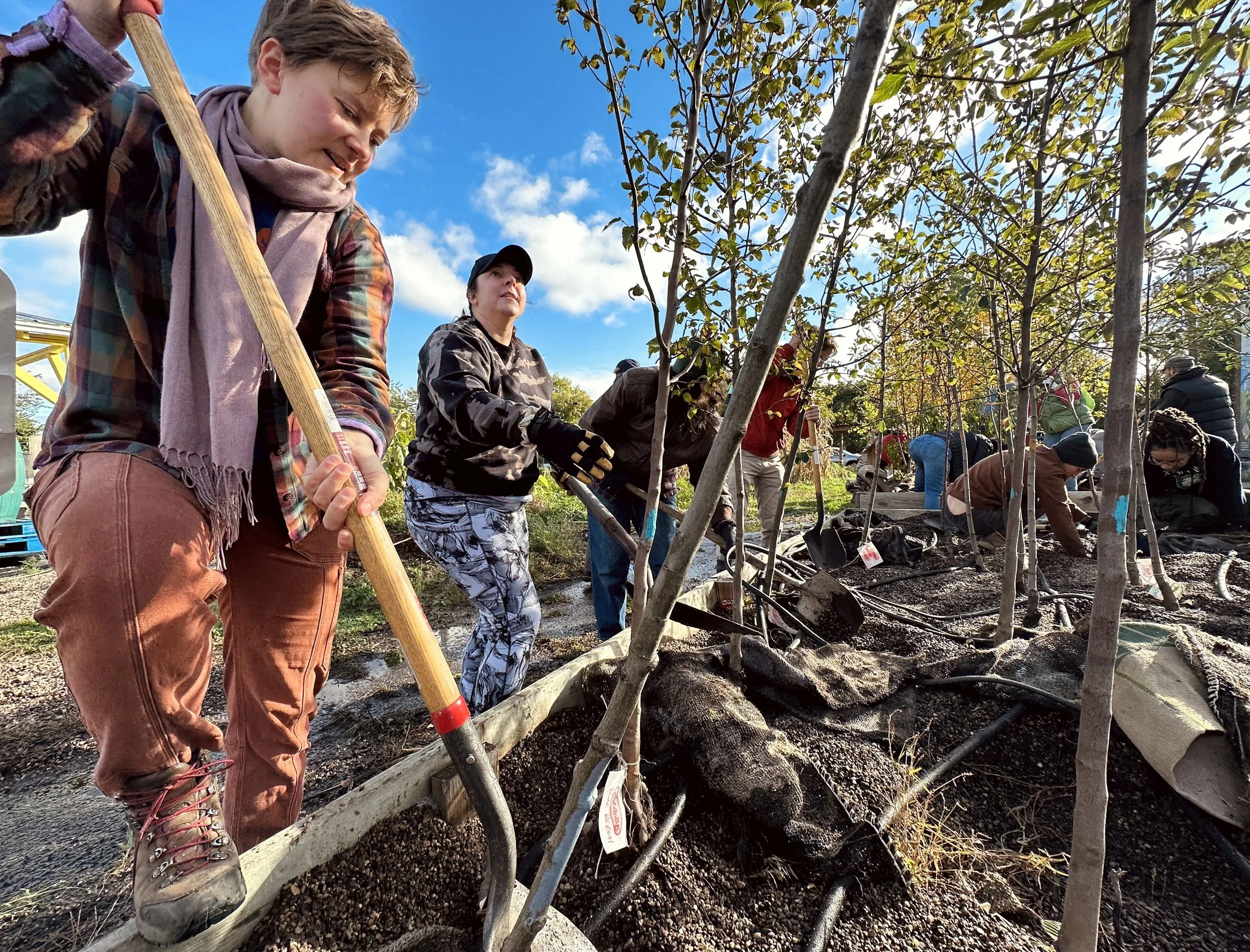
Where to put each species?
When choosing which tree species to plant at a location, we work with our community partners to answer a number of questions about the site, including:
-
How much sunshine does this area receive?
What are the soils like?
Does the area flood frequently?
How much road salt would a tree here be exposed to?
Where does snow get plowed into piles in the winter?
-
Which other species are present?
Which species have done well? Which are struggling?
Are any species overrepresented?
-
How do people use this area?
Are there sports fields that should be kept clear of plantings?
Where would shade most benefit the people gathering in or moving through the area?
Taking the time to answer these questions helps to ensure that we are planting the right trees in the right places, giving them the best chance at survival.
For more information on tree species selection, check out these great resources from Hennepin County, the Minnesota Department of Natural Resources, and the University of Minnesota!
Funding for this project provided by the Minnesota Environment and Natural Resources Trust Fund as recommended by the Legislative-Citizen Commission on Minnesota Resources (LCCMR) or by the U.S. Department of Agriculture Forest Service through the Urban and Community Forestry Program. USDA and Great River Greening are equal opportunity providers and employers.